

Le Mura
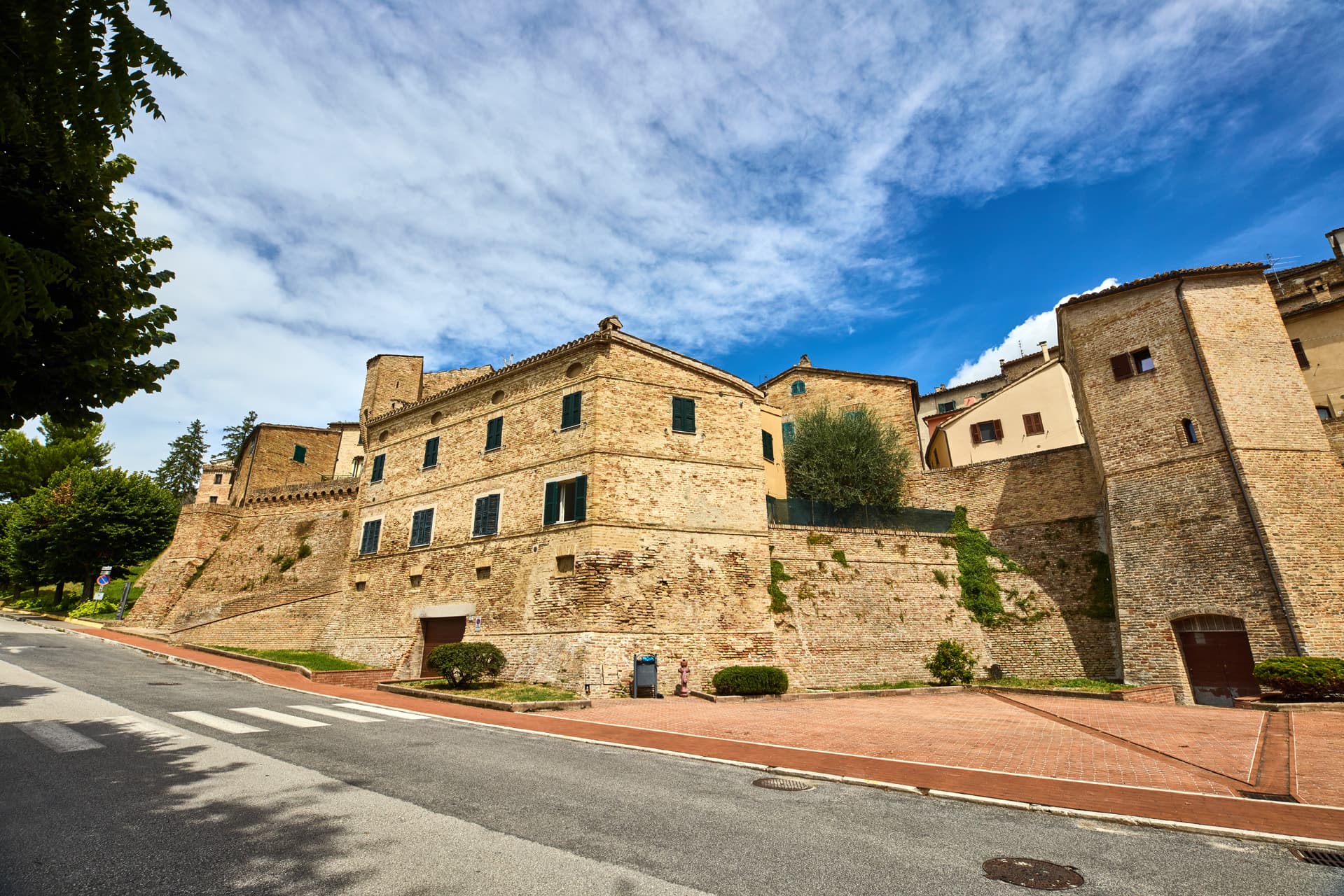
The Walls – The fortified perimeter surrounds the 13th-century urban structure, transformed first in the late Middle Ages and then modernly under the pressure of economic and social changes. The city walls are broken by ten towers and a monumental fortified gate
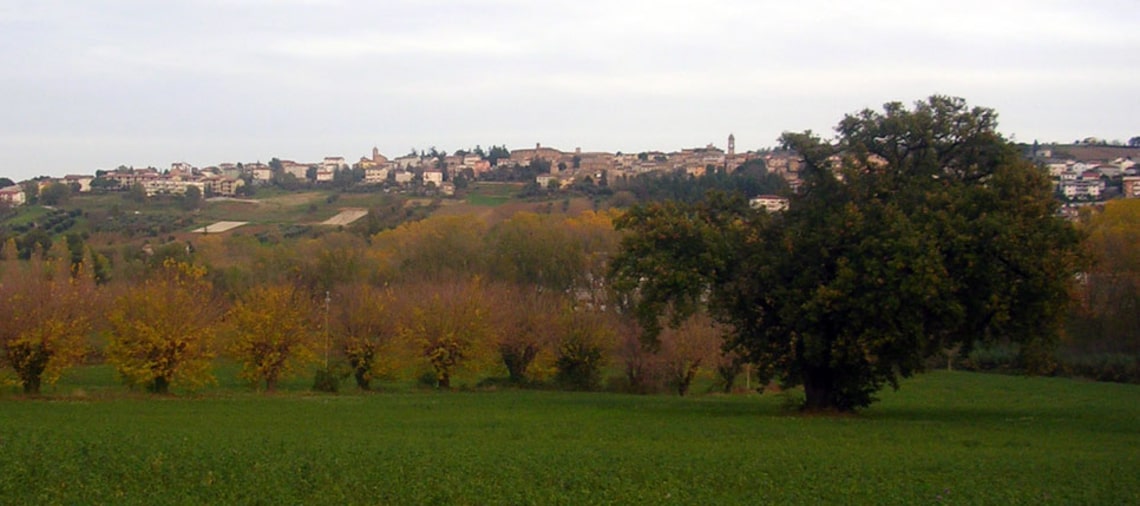
The historic center of Serra de’ Conti offers a significant example of a 13th-century urban layout, adapted and transformed first in the late Middle Ages and then in the modern era under the pressure of economic and social changes. Along the perimeter of the ancient city, located on a hilly ridge along the Misa River valley, runs the city walls broken by ten towers and a monumental fortified gate. We can identify, over the centuries, three distinct construction phases. The construction of the first fortified nucleus, namely the Girone (12th-12th century). The term “Girone” is still used in the language spoken in the municipalities of Senigalliese to indicate the highest place in the historic center on which stood a fortification equipped with an access gate that enclosed within it a tower and a stately palatium. In Serra de’ Conti this original fortified nucleus stood on the highest part of the hill, following the axis of Via Garibaldi, in an area that roughly affects the part between today’s Piazza IV Novembre and Piazza Gramsci and limited to the west by Corso Roma. Outside the Girone there were villages that were later incorporated into the city walls. The first expansion dates back to the years 1280-1350. During this period, the expansion of the walled centre affected the western side of the hill, the one with the lowest slope. The settlement takes on a more complex, typically medieval form, with the presence of a main road axis (identifiable as the current Corso Roma) and two other parallel lateral roads. Furthermore, the insertion of an identifiable orthogonal axis is recorded in the current staircase leading to Porta della Croce. The expansion of the urban space also necessitated a renovation of the fortification system: towards the end of the 20th century, the access gates became three and their name corresponds to the three ancient Benedictine churches outside the castle (Santa Maria, Santo Stefano di Busseto, and Santa Lucia). A subsequent expansion of the perimeter occurred in the 15th century with restoration and expansion of the castle walls that continued until the following century. Of the three original gates, only the Porta della Croce remains; the other two were demolished during the 19th century. The Porta della Croce is one of the most significant examples of 14th-15th century military architecture. It was originally equipped with a drawbridge and guarded by towers. It consists of two parts built in successive times. The first corresponding to the internal round arch dates back to ‘200 and was originally surmounted by a walkway protected by square battlements called “Guelph”. The second external part with a Gothic arch and rotated 90 degrees with respect to the oldest dates back to the 17th century. XIV advanced and was equally surmounted by a walkway protected by dovetail battlements called “Ghibelline”. In 1648, the lunette of the internal arch was frescoed with a Deposition of Jesus from the Cross, today transferred for conservation reasons to the church of Santa Croce (located on the right wall) and replaced with a contemporary work of the same subject by Maestro Bruno d’Arcevia. Porta Santa Maria was demolished in 1867 because it hindered the transit of carts and deprived the convent of San Carlo of air and light. The same fate befell the Porta di Santa Lucia, rebuilt in a more advanced position and in neo-classical style in the mid-19th century and partially dismantled after 1882 for reasons similar to those seen for the Porta di Santa Maria. In 1826, the Girone tower, considered unsafe, disappeared and in the following years various renovation and consolidation works were carried out on the wall circuit. In 1828 the section of walls to the right of the Porta della Croce was redone, in 1849 the north-eastern section (under the former hospital) was restored and in 1867 the segment under the Franciscan garden was redone. The vast consolidation of the walls under the convent of Santa Maria Maddalena dates back to the 1930s with the insertion of sturdy buttresses.
Gallery
Where
Contacts
Address
centro storico
Other Information
Categories
Storico, Architettura
You might also be interested
CONO.S.C.I.AMO.CI - conoscere, Serra De` Conti, con intraprendenza, amore e civiltà - Questo intervento è stato realizzato con il contributo dell’Unione europea Bando POR FESR Marche 2021-2027 - Asse 1 - Azione 1.2.2 - Int. 1.2.2.2 Bando per “Servizi digitali integrati”



