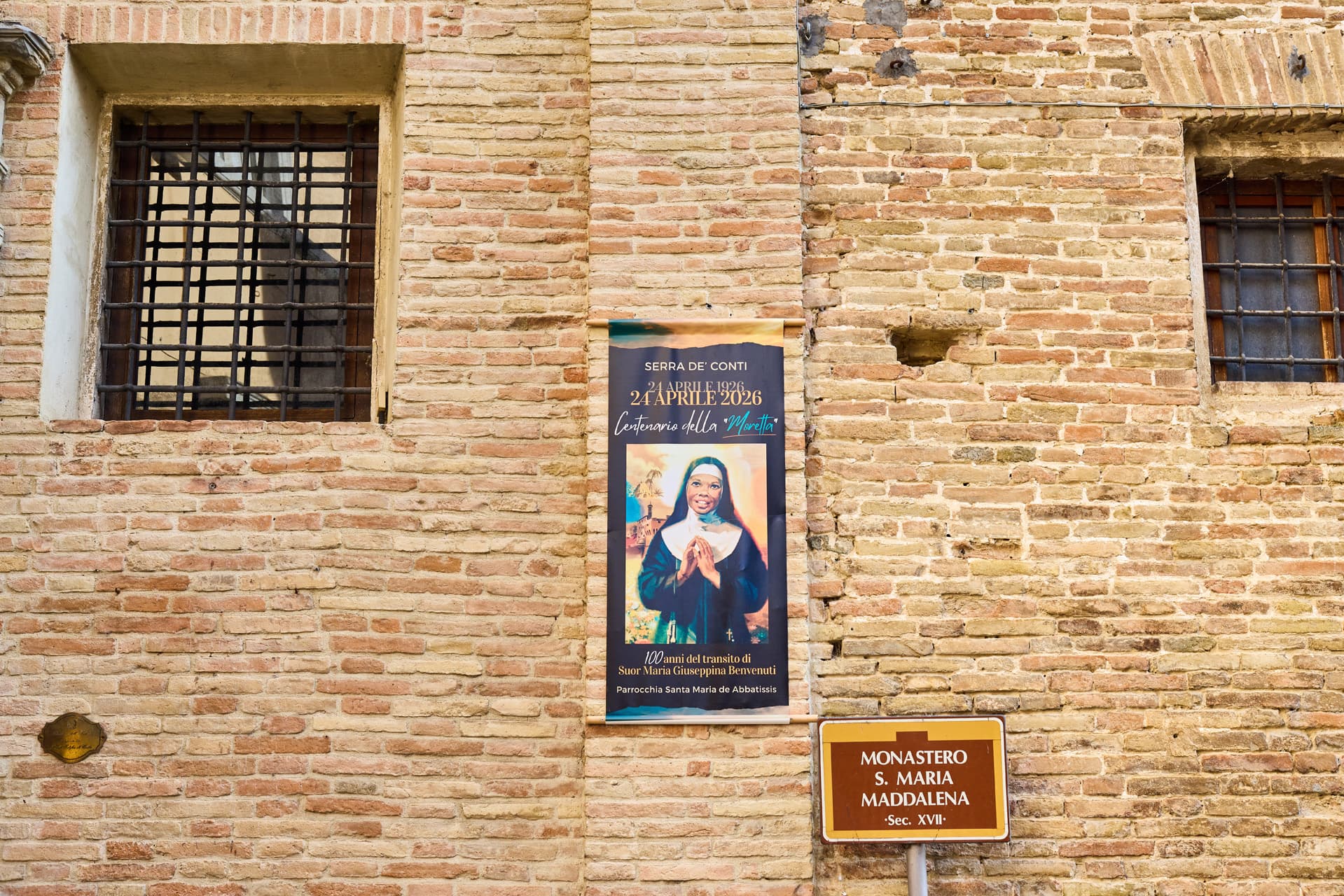
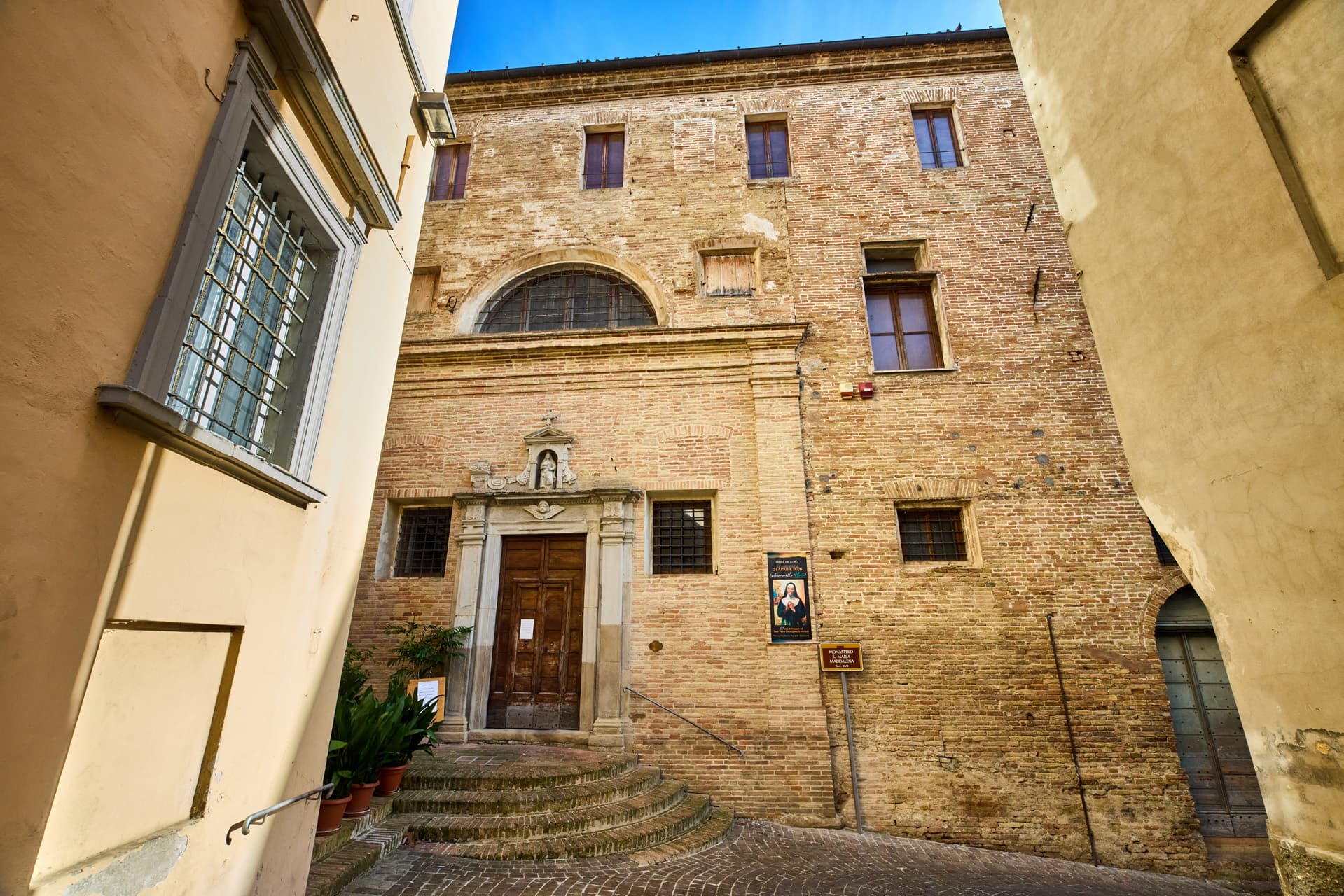
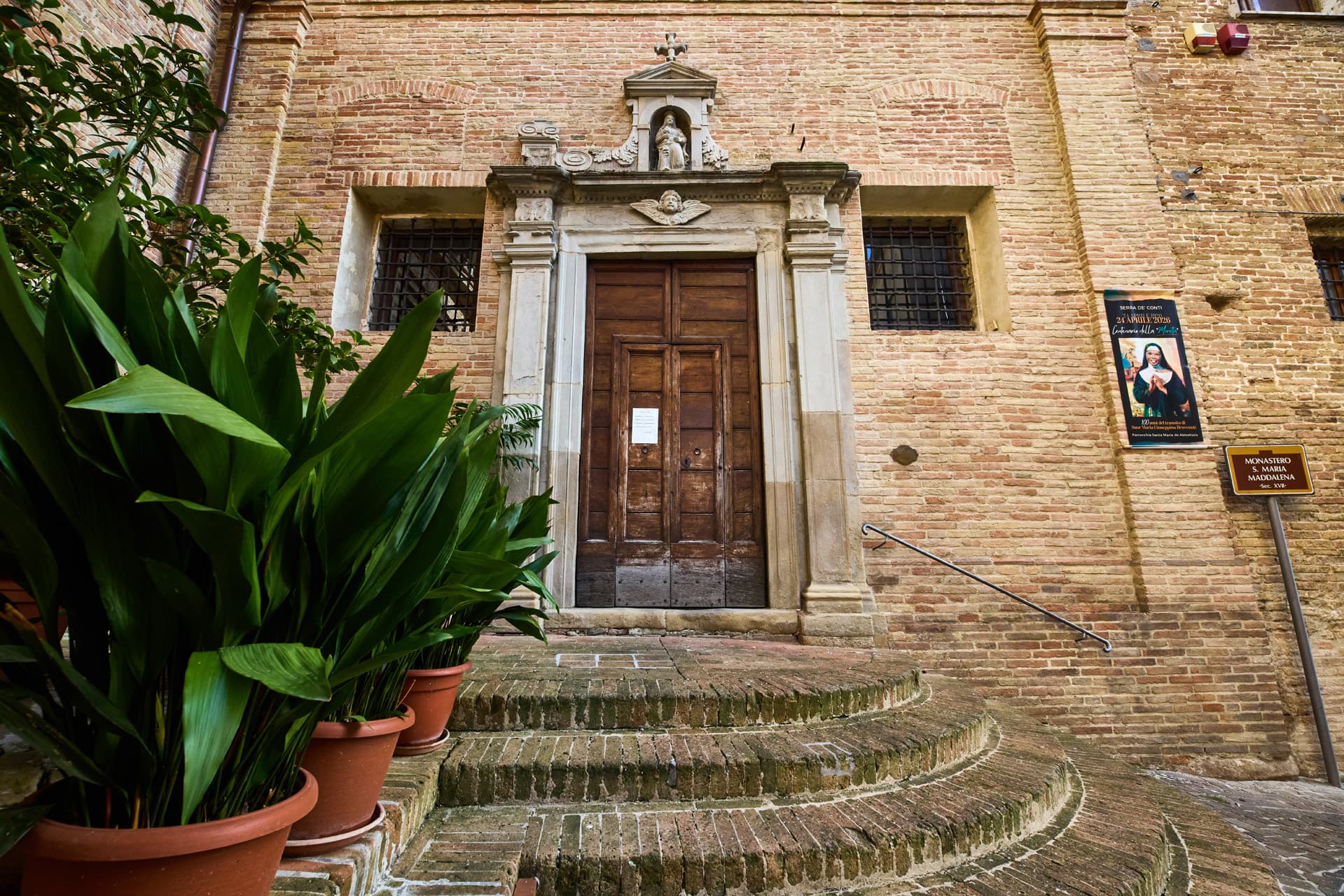
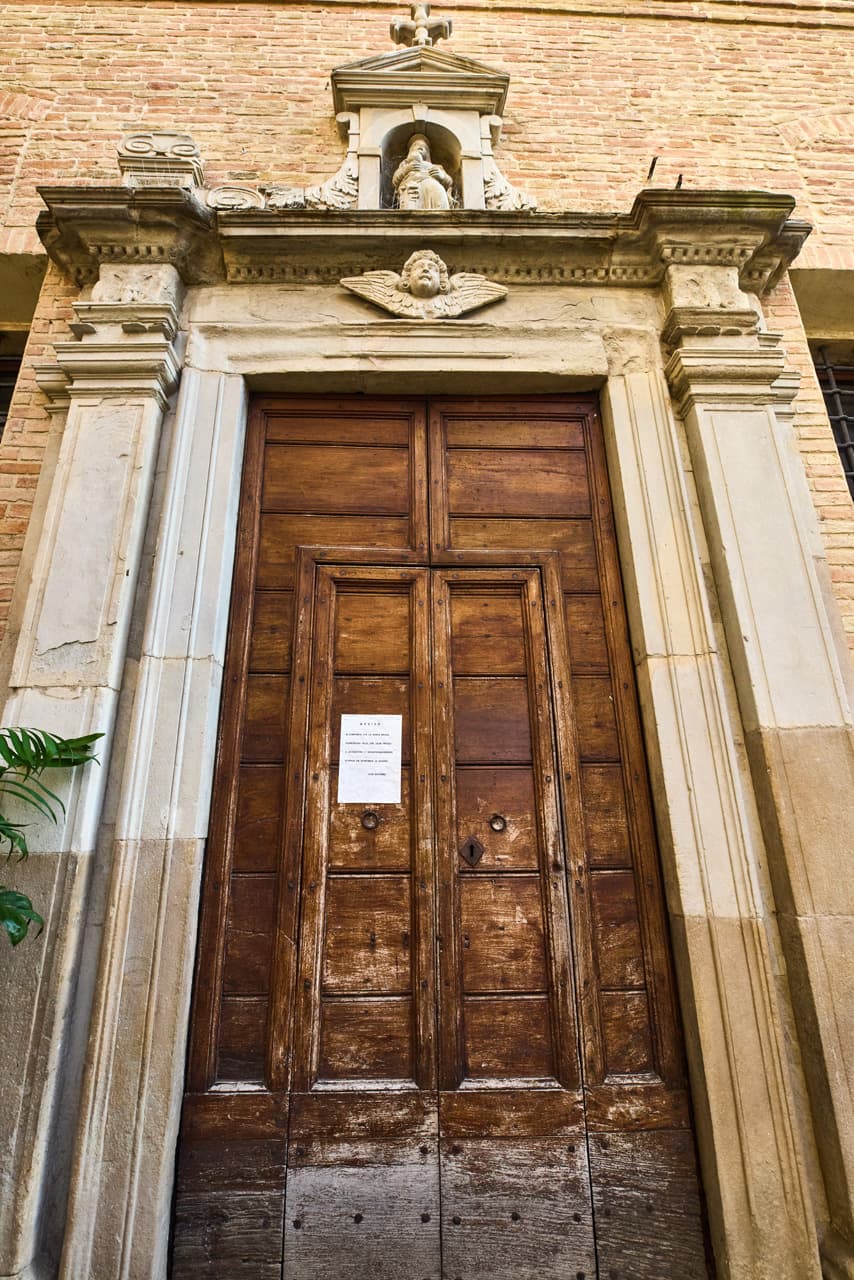


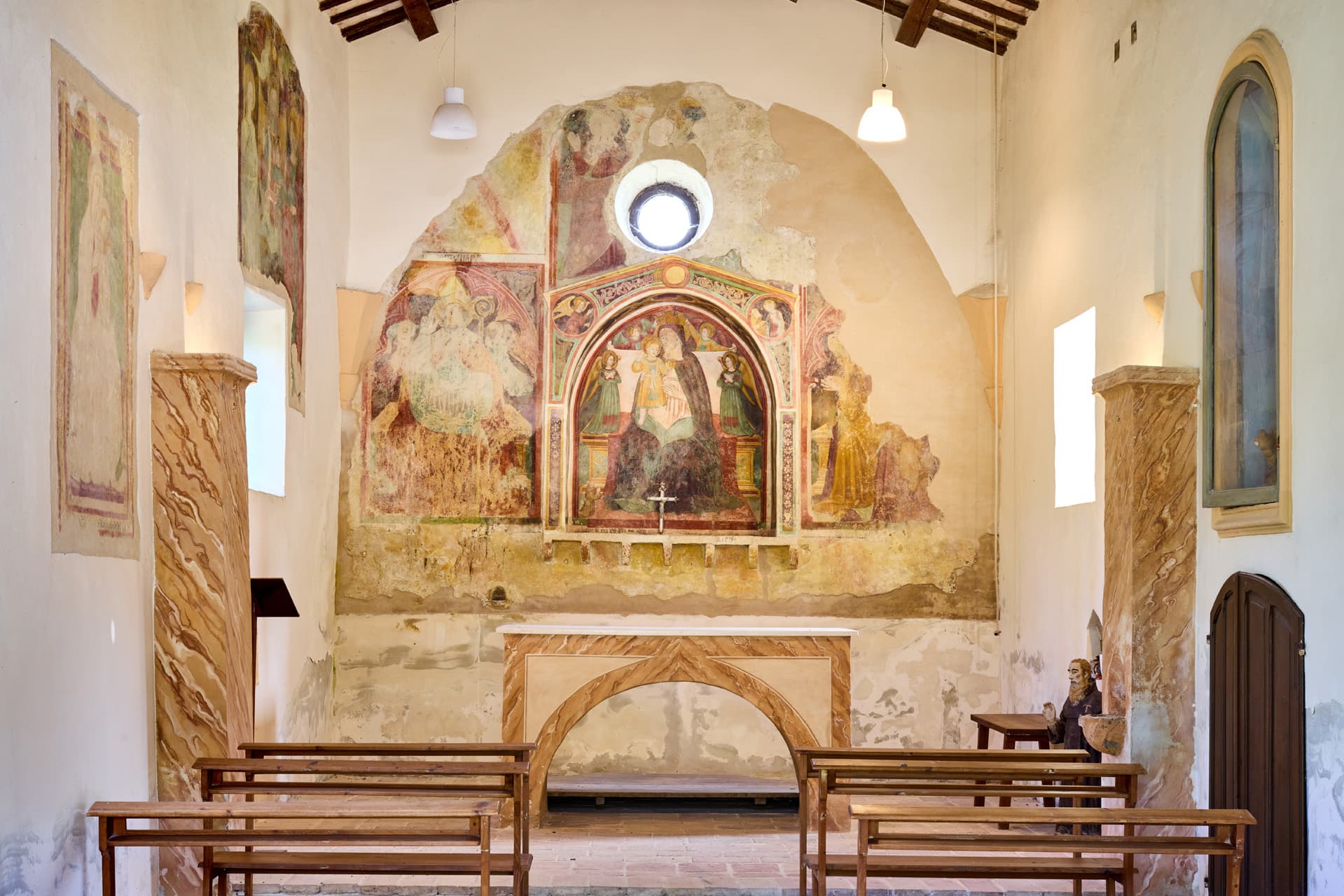
Church of Santa Maria Maddalena
Work on the construction of the Church of Santa Maria Maddalena began in 1603, about twenty years after the reopening of the convent, a much larger complex of which the church is part, and was completed no earlier than the end of the century. The structure, incorporated into the monastic complex of the same name, is interesting for the particular ellipsoidal shape of the plan, which seems to evoke the soft openings and closures of the curvilinear space designed by Borromini for the Roman church of S. Mary of the Seven Sorrows (1643-1646) of the cloistered order of the Augustinian Oblates.
Borromini’s influence is also strengthened by the presence of the four side doors (painted in grotesques), the single order of pilasters and the oval shape of the choir. The monastic community, moreover, boasted consolidated relationships since the beginning of the seventeenth century with the Philippine Fathers of the Roman Convent of S. Filippo Neri, where Borromini was active between 1637 and 1660. Of particular interest are the wooden furnishings, whose ornaments of high artistic quality distinguish the noble environment of the monastery. A recent restoration has restored the ancient materials and original colors by eliminating the superstructures that have accumulated over the centuries. The vault, punctuated by stucco decorations, is decorated in the centre with a fresco (17th century. XVIII) depicting St. Mary Magdalene carried to heaven by angels. On the sides, within medallions with stucco frames, are the Evangelists. The painting placed on the high altar was executed by the Flemish painter Ernst De Schaych (Utrecht, 1567-1631) in 1617, during a stay in the Marche region that also led him to work in other locations in the region. It is a depiction of the Madonna della Cintola, which represents the Madonna enthroned with the Child handing over the belts, symbol of the Augustinian order, to St. Augustine and S. Monica, surrounded by figures of kings and queens, popes and bishops, in reference to temporal and spiritual power. In the foreground, at the lower end of the painting, are the busts of four saints (S. Francis, S. Mary Magdalene, S. Joseph and St. Bernardino of Siena). Below the date and the artist’s signature are the initials and coat of arms of the Innocenzi family of Ostra Vetere, who commissioned the painting on the occasion of the appointment of a niece, a nun, as vicarious mother at the Monastery of S. Mary Magdalene. The canvas painted in 1668 by Clemente Maioli from Ferrara testifies to the artist’s passage through the Marche after his period in Rome, where he was active from 1634, and before his definitive return to Ferrara in 1671 ca, a few years before his death. The work located on the left altar represents the Assumption of the Virgin, with the Madonna transported to heaven by a choir of angels before the Apostles gathered in prayer around the tomb. The balanced scenic construction of the space, clearly derived from Emilia, together with the attention to Venetian culture (Tintoretto), are drawn from a work by Annibale Carracci on the same subject, preserved at the Pinacoteca Nazionale in Bologna. On the right altar there is a canvas attributable to the local painting scene of the second half of the seventeenth century.It depicts Our Lady of Mount Carmel, with the crowned Virgin and Child, offering the scapular to Simon Stock, an English friar and founder of the Carmelite order, never officially canonized but highly venerated in the Catholic Church. According to tradition, the scapular saves the wearer from hellfire. They surround the figure of the friar S. Chiara, S. Bonaventure, S. Sebastian and S. Peter Martyr, Dominican friar who suffered martyrdom in the fight against heresies. Five other saints are depicted at the bottom half-length: St. Catherine of Alexandria, S. Lorenzo, S. Philip Neri, S. Nicholas of Tolentino and St. Agate. Behind the main altar, through a golden grate, you can see the Andrea Gennari organ from 1827/1828, restored in 2001 and still in working order. The organ houses a drum and bells, as was often the case with nineteenth-century Italian organs.
Gallery
Multimedia
CHURCH OF SANTA MARIA MADDALENA - Municipality of Serra de' Conti - Interior ENG
CHURCH OF SANTA MARIA MADDALENA - Municipality of Serra de' Conti - Main Altar ENG
Where
Scan the QR code
To reach the point of interest
Via Guglielmo Marconi 4
Distance by car: 30 min RaggiungiContacts
Address
Via Guglielmo Marconi 4
Other Information
Categories
Monumento, Storico
CONO.S.C.I.AMO.CI - conoscere, Serra De` Conti, con intraprendenza, amore e civiltà - Questo intervento è stato realizzato con il contributo dell’Unione europea Bando POR FESR Marche 2021-2027 - Asse 1 - Azione 1.2.2 - Int. 1.2.2.2 Bando per “Servizi digitali integrati”



